

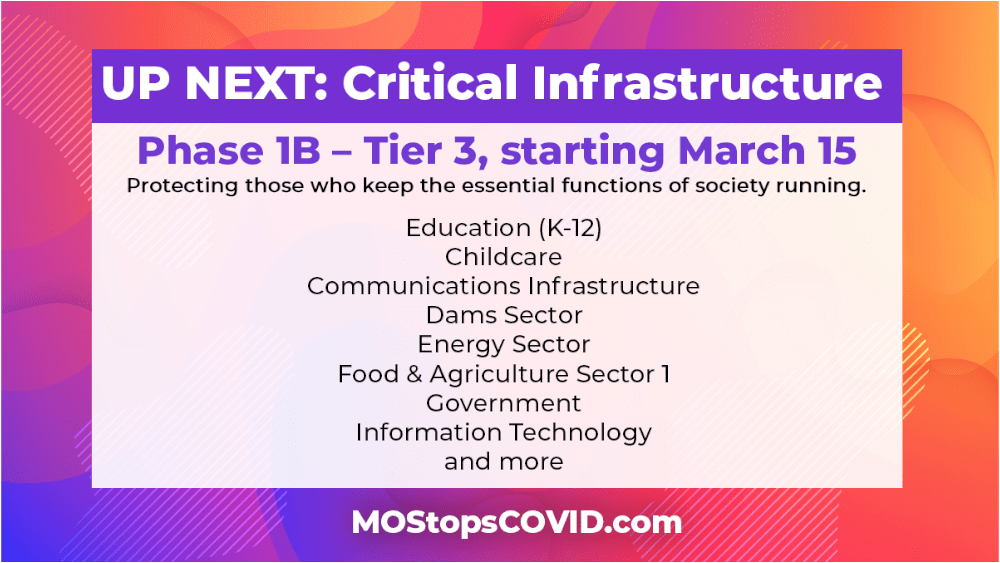
As many anxiously await their turn to be vaccinated against COVID-19, the state of Missouri recently announced the opening of another tier of eligible individuals effective March 15. That tier is defined as those working in what the state is calling “critical infrastructure,” or those who preserve the essential functions of society.
State officials are quick to note that this next phase will exacerbate the vaccine shortage in some areas, as there will be more eligible individuals added to rosters than there are vaccine doses available. However, Missouri has seen a slight increase in the numbers of doses slated for distribution through the month of March.
The Missouri Department of Health and Senior Services estimates another 19% of Saline County’s population will become eligible to receive the vaccine upon the opening of Phase 1B, Tier 3, which includes:
- Education – Teachers, faculty and staff in pre-K through 12th grades in all public and private schools
- Childcare – Those working childcare in a DHSS or DHSS-licensed facility
- Communications sector – Employees at public, private or nonprofits that provide communications services
- Dams and Energy – Employees who work in water retention and control services, and energy services of all types
- Food and Agriculture Sector 1 – Employees in food production and processing, distribution and retail sales including grocery and convenience store workers
- Government – elected officials and employees at any level or branch of government
- Information technology sector – Anyone who provides IT services
- Nuclear reactors, materials and waste sector – Anyone who works in any facet of this sector
- Transportation systems – Employees in aviation, highway, motor carriers, maritime transportation, mass transit, passenger rail, pipeline systems, freight rail and postal shipping services
- Water and Wastewater systems – Employees in drinking and wastewater services
To help get these newly eligible individuals vaccinated, Fitzgibbon Hospital, partnering with local health departments, colleges and schools, will be offering several large first-dose clinics in March. They also have set aside dedicated times at each of these events to vaccinate walk-ins. The staff make every effort to accommodate those with appointments first but will also vaccinate eligible individuals who walk in, as long as there is vaccine available.
Walk-ins will be accepted at each first-dose event from 9 a.m. to 11 a.m. and again from 2 to 4 p.m. The clinics are closed for staff lunch break from noon to 1 p.m.
Upcoming first-dose events are scheduled for 8 a.m. to 5 p.m., Friday, March 12, at the Malcolm Center at Missouri Valley College; from 8 a.m. to 11:30 a.m. on Monday, March 15, at the Glasgow High School in Glasgow and from 1:30 to 5 p.m. at Slater High School in Slater; and on Wednesday, March 17, at Central Methodist University in Fayette.
An updated listing for the next two weeks of first-dose clinics staffed by Fitzgibbon Hospital and clinic personnel is available at www.Fitzgibbon.org. Those wishing to register in advance will be guaranteed their vaccine when scheduled for an appointment. Go to www.fitzgibbon.org/preregister. For more information about eligibility, go to www.mostopscovid.com
And according to recently released data published by the Missouri Hospital Association, for the seventh consecutive week, COVID-19 activity continued to recede in Missouri last week. New cases as a rate of the population increased just 0.6%, the lowest weekly increase since early October of 2020.
The statewide positivity rate decreased by 1.2 percentage points to 5.8% last week, and suspected and confirmed COVID-19 hospitalizations fell below 1,000 patients for the first time since Sept. 20, 2020.
On Feb. 28, Missouri hospitals reported 989 hospitalized patients, a 64% decrease since the first week of January. Compared to the previous week, staffed inpatient bed availability decreased by 10.9%, ICU bed availability increased 1.8% and 73.4% of mechanical ventilators were available statewide last week.
An emerging issue, however, is that more than 55,000 Missourians are past due for their second “booster” dose. Through March 1, 2021, a reported 56,720 individuals in the state have yet to receive booster doses within the manufacturer-prescribed window of 21 days for Pfizer and 28 days for Moderna vaccine. This accounts for roughly 6.5% of all individuals who have received any dose in Missouri, and among those, only 1,817 are beyond the date issued in the latest guidance from the Centers for Disease Control and Prevention. That guidance recommends booster doses be administered within 42 days of the first dose. Nationally, the rate of those who fail to complete the series of two vaccinations is 12%.